
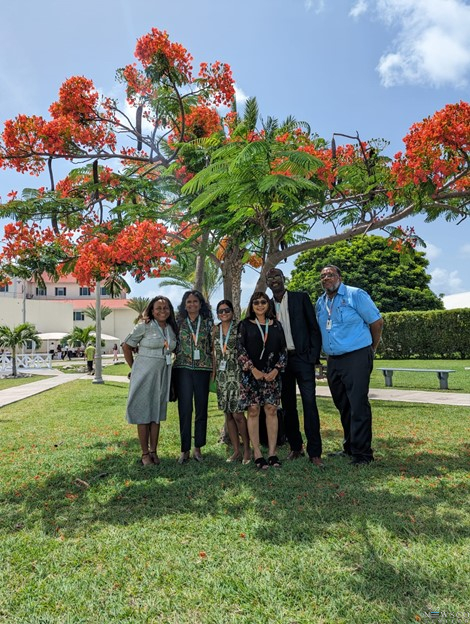

St Augustine Campus experts: Dr Preeya Mohan, Senior Research Fellow, SALISES, Professor Michelle Mycoo, Professor of Urban and Regional Planning, Dr Ronald Roopnarine, Senior Lecturer, Faculty of Food & Agriculture, and Dr Sandra Sookram, Director, SALISES.
Members of the University of the West Indies (UWI) community have shared their thoughts in the aftermath of the 4th International Conference on Small Island Developing States (SIDS4) which was held in Antigua and Barbuda.
In a press release issued over the weekend, UWI experts—represented by over 25 leaders and academics –expressed their thoughts on the four-day conference where they, as academics, met with leaders and other experts from across the world, contributing to critical dialogues and solution-driven strategies to address pressing issues affecting SIDS.
Director of the Centre for Marine Sciences at UWI Mona, Professor Dale Webber noted the importance of exploring deep-sea ecosystems, which have been largely unexplored by SIDS.
“SIDS, especially in the Caribbean, have seldom had opportunities to explore, with profundity, our deep-sea ecosystems. Enhancing our deep-sea science capabilities through the International Seabed Authority’s capacity development and institutional strengthening contributions would be extremely beneficial. This knowledge is crucial for sustainable resource management and conservation,” he said.
Director of the Centre of Excellence for Oceanography and the Blue Economy at UWI Five Islands, Dr Branson Belle stressed the importance of aligning educational objectives to maximise the impact of partnerships and capacity development opportunities.
“Leveraging partnerships in education and research is critical to enable SIDS to participate and benefit from opportunities arising from the emerging blue economy,” Dr Belle noted.
Senior Lecturer, Faculty of Food and Agriculture at the St Augustine campus, Dr Ronald Roopnarine, said that the adoption of the Antigua and Barbuda Agenda for SIDS (ABAS) was a “significant advancement, securing tangible financial commitments from developed nations to support sustainable development and enhance climate resilience in Small Island Developing States.”
“This assistance is vital for our survival, yet we must aspire to more than mere subsistence. The quality of our existence hinges on establishing strong economies. While developmental aid is welcomed, building resilient economies is vital.
“At a regional level, we must also examine our own contributions to the challenges we face. Although climate change is a major concern, it is not the only factor that has changed over the past 30 years. Our approaches to managing, developing, and utilizing resources have, in many ways, compounded the impacts we are experiencing,” he said.
Meanwhile, Dr Preeya Mohan, Senior Research Fellow at the St Augustine campus, highlighted the critical role of climate finance in empowering academic institutions, highlighting how funding can support vital research and educational programmes on climate change.
She stated that “access to climate finance can empower academic institutions like UWI in the climate fight. Funding can support our vital research and develop educational programmes on climate change for students, communities, and policymakers.”
She also pointed out that such funds can foster collaborative projects with local communities, promoting knowledge exchange and regional solutions.”
Additionally, Dr Jan Yves Remy, Director of the Sir Shridath Ramphal Centre at UWI Cave Hill Campus, underscored the need for cross-sectoral collaboration to advance the green trade agenda, stating, “Climate people need to talk to shipping people, need to talk to people in the environment, need to talk to people in the trade.”
Christian Virgil, PhD Student in the Department of Mechanical and Manufacturing Engineering at UWI St Augustine, highlighted the fact that approximately EUR 300 billion in funding is needed to address the adaptation deficit and that while, as a matter of climate justice, the international community must accelerate efforts to make funding available to vulnerable SIDS.
“Equally important is the need for SIDS to build the capacity to absorb adaptation funding as it becomes available. Securing these funds while simultaneously developing local institutional capacity is essential for fostering resilience to the impacts of climate change,” he said.
Professor Michelle Mycoo, Programme Coordinator of the Urban and Regional Planning Programme at the Department of Geomatics Engineering and Land Management at UWI St Augustine emphasised the power of data and digital technologies.
As a member of THE SIDS Liaison Committee of the International Science Council, Vice President of UNESCO’s Scientific Advisory Committee of the Management of Social Transformations Programme and an advocate for using the Climate Vulnerability and Resilience Index, she noted that research and data gaps related to the informal sector needs to be addressed.
She also recognised that adaptation must be quantified for its efficacy and social cost benefit to better understand the region’s capacity to move toward resilience.
Dr Legena Henry from UWI Cave Hill, highlighted the need for better intellectual property protection for innovators from small islands. She noted that “ensuring that local innovations are safeguarded, and creators can benefit from their work is crucial.”
The UWI said that it remained steadfast at the forefront, driving research, education, and policy development to support the efforts of SIDS.