
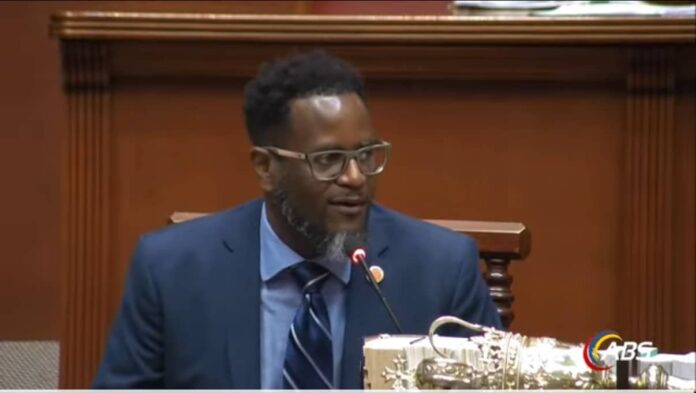

The Director of the Social Security Board of Control, David Mathias, has warned that Antigua and Barbuda’s Social Security Fund could face a solvency crisis by 2030 unless urgent steps are taken to strengthen its investment portfolio.
Speaking in Parliament on Monday morning, Mathias said the Fund’s single fiduciary responsibility was to ensure its long-term solvency. He pointed to actuarial reports which show that at current contribution rates, the scheme will reach “forced equilibrium” within the next five years.
“By 2029, the latest 2030, if no further corrections are made, we are at a place where we will once again be forced to make another set of parametric changes,” he said.
Mathias argued that simply raising contribution rates or the pension age is not viable. He said he does not believe there is “economic space” for contribution rates beyond 20%, nor public appetite for a pension age above 67. Instead, he stressed the need for “greater return from our investment portfolio,” highlighting diversification and strategic alignment as critical.
Currently, Antigua and Barbuda has around 12,000 pensioners supported by just 47,000 contributors. Ideally, Mathias said, a viable system should have ten contributors for every pensioner — a gap that can only be bridged by significantly higher investment income.
“To cover the shortfall, you would need to generate returns closer to six percent, preferably ten,” he explained.
Mathias warned that without stronger investment returns, the Fund will struggle to cover pension payments, let alone operating costs, by 2030. “The need for this discussion is now,” he told MPs, urging that Social Security be treated as a national issue.
He also outlined the structural challenge facing the system: contributors’ lifetime payments are typically exhausted within two years of retirement, after which pensions must be funded by current workers. With birth rates in decline and net migration uncertain, he cautioned that the number of future contributors may not be enough to sustain the scheme.
“As I sit here today, I can say that by one o’clock this afternoon, pensions will be paid. I cannot say that will be the case in the next ten years if real effort is not made,” Mathias said.