
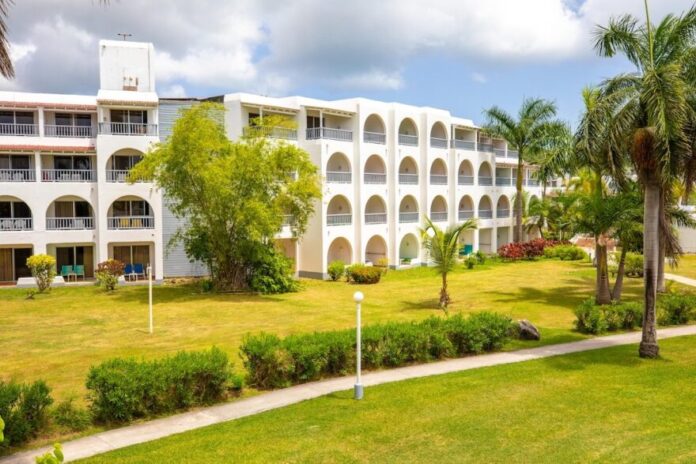

Prime Minister Gaston Browne has cautioned against transforming Jolly Beach into an exclusively high-priced luxury resort, saying the property currently serves as an affordable gateway for thousands of visitors to Antigua and Barbuda.
Speaking Saturday on the Browne and Browne Show on Pointe FM, Browne said the government remains conflicted over the future positioning of the resort as several international investors pursue the property.
He said a longtime visitor had advised the government against selling Jolly Beach or converting it into an upscale hotel beyond the financial reach of average travellers.
The visitor reportedly told Cabinet that Jolly Beach had allowed him to visit Antigua and Barbuda for more than 20 years because of its comparatively affordable rates.
“He said, ‘Look, this is your gateway to Antigua,’” Browne recalled.
The prime minister said the visitor argued that ordinary travellers could afford a week at Jolly Beach, enjoy one of Antigua’s best beaches and receive a satisfactory hospitality experience without paying luxury-resort prices.
Browne said that argument had merit because Jolly Beach accommodates up to 75,000 visitors annually in its current form.
“He’s not wrong, because Jolly Beach in its current state accommodates up to 75,000 tourists a year,” Browne said.
The prime minister expressed concern that transforming the property into an ultra-luxury resort could result in nightly rates approaching US$1,000, effectively removing one of Antigua and Barbuda’s more accessible large resorts from the market.
The final product would depend on the investor and hotel brand selected, Browne said.
He suggested that an arrangement involving Marriott could produce a resort similar to Royalton, while Club Med could offer a different type of product.
A Chinese investment group has reportedly considered developing a high-end resort that could seek affiliation with Rosewood. Browne said the group viewed a luxury property as appropriate because Nikki Beach, another upscale development, is planned for the surrounding area.
However, any Rosewood development would require the hotel company’s approval before the brand could be used.
The government is also considering the economic value of keeping a large number of hotel rooms operating during redevelopment.
Browne said prospective investors were not merely considering renovations but wanted to demolish the existing Jolly Beach buildings and construct a new resort.
The government has asked that any demolition and reconstruction be conducted in phases.
Jolly Beach occupies approximately 27 acres, Browne said. Government inquiries indicated that about 200 rooms are situated on roughly seven acres.
Under the phased approach, an investor could retain those 200 rooms while redeveloping the remaining 20 acres, including the removal of about 150 rooms.
Once the first phase was completed, the developer could move to the remaining seven acres and replace the other 200 rooms.
That approach would allow approximately 200 rooms to remain available during construction, reducing the effect on Antigua and Barbuda’s hotel-room inventory, visitor arrivals and tourism employment.
Browne said at least four sets of investors had expressed interest in purchasing Jolly Beach. Two groups had already visited Antigua and Barbuda during the year, while another two were expected within 10 days of his remarks.
The interested parties include Club Med, a Chinese group and the owner of Iberostar. The Barrett Group was also expected to bring prospective investors to inspect the property.
According to Browne, the Chinese group had indicated a possible purchase price of between US$30 million and US$35 million.
He described Jolly Beach as a prized tourism asset and said the government believed a sale could generate close to EC$100 million.
Jolly Beach was transferred to the Social Security Scheme as part of an arrangement to settle government debt owed to the institution.
Browne defended that decision, saying the government exchanged unpaid debt for an income-producing asset that generates approximately EC$4 million annually.
He said a successful sale would provide Social Security with funds that could be invested in another productive asset.
No agreement has been finalised, and the government has not identified a preferred purchaser or hotel brand.
Browne said the decision must balance the potential financial return from a luxury development with the importance of maintaining an affordable resort that brings tens of thousands of visitors to Antigua and Barbuda annually.
Source: Antigua News Room PM Browne Cautions Against Turning Jolly Beach Into High-Priced Luxury Resort.