
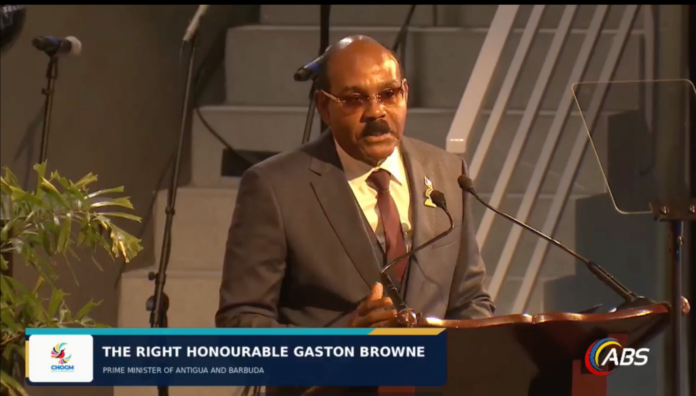

PM Browne at the CHOGM Opening ceremony
Prime Minister Gaston Browne has called on Commonwealth leaders to push for faster access to climate financing and more flexible debt arrangements for vulnerable countries, warning that a single devastating hurricane can wipe out decades of development and force governments to divert money from essential public services toward disaster recovery.
Addressing the opening of the 28th Commonwealth Heads of Government Meeting (CHOGM) in Antigua and Barbuda, Browne argued that the international financial system must do more to recognize the particular challenges facing small island developing states, whose economies can suffer catastrophic damage from natural disasters despite their relatively high national income classifications.
The prime minister said the pursuit of economic prosperity must be accompanied by greater recognition of the vulnerabilities that threaten to reverse years of national progress.
“Our pursuit of prosperity must also recognise the vulnerabilities that threaten to erase decades of development in a matter of hours,” Browne told Commonwealth leaders.
“A single hurricane can devastate infrastructure, destroy livelihoods and force governments to divert resources from education, healthcare and economic transformation towards recovery.”
His remarks highlighted a longstanding concern among Caribbean governments that the financial consequences of major hurricanes extend far beyond the immediate destruction of homes, businesses and public infrastructure.
For small island economies, the loss of critical infrastructure and economic activity can place severe pressure on public finances, leaving governments to finance reconstruction while maintaining essential services and meeting existing debt obligations.
Browne argued that international financing arrangements must better reflect those circumstances, rather than relying primarily on national income to determine whether countries qualify for concessional assistance.
“National income alone cannot adequately measure a country’s vulnerability or its capacity to withstand repeated shocks,” he said.
The prime minister specifically urged Commonwealth countries to support wider use of the Multidimensional Vulnerability Index (MVI), a United Nations-backed framework intended to provide a more comprehensive assessment of countries’ exposure to economic, environmental and other external shocks.
The index is particularly important for small island developing states, many of which are classified as middle- or high-income economies but remain highly exposed to hurricanes, rising sea levels and disruptions to international trade and tourism.
Traditional financing criteria frequently rely on gross national income per capita, which can limit access to low-interest development loans and other forms of concessional financing.
The United Nations has acknowledged that such measures do not adequately capture the higher costs faced by small island states in maintaining infrastructure, responding to disasters and servicing debt.
The MVI is intended to complement existing economic indicators by incorporating structural vulnerabilities and resilience into assessments of development needs.
Browne urged Commonwealth governments to use their collective influence to advance that reform.
“We must therefore advance the wider use of the Multidimensional Vulnerability Index alongside existing financing criteria, while pressing for faster access to climate finance and debt arrangements that give vulnerable countries the fiscal space to recover and rebuild,” he said.
The proposal would not automatically guarantee additional funding, but wider adoption of the index by international financial institutions could strengthen the case for more affordable financing for countries facing severe climate risks.
Browne also called for debt arrangements that would allow vulnerable governments to respond to emergencies without placing further strain on their long-term financial positions.
“No nation should be forced to mortgage its future simply to survive the present,” he declared.
The warning reflects a broader concern that countries repeatedly exposed to natural disasters can become trapped in a cycle of borrowing, reconstruction and renewed financial vulnerability.
When governments must borrow substantial sums to rebuild damaged roads, schools, hospitals, electricity networks and other infrastructure, the resulting debt obligations can reduce the resources available for future investment and public services.
The prime minister’s argument carries particular significance for Antigua and Barbuda, where Hurricane Irma devastated Barbuda in September 2017.
The Category 5 hurricane damaged or destroyed approximately 95% of properties on Barbuda and forced the evacuation of the island’s population.
Recovery needs were estimated at approximately US$222 million, equivalent to about one-fifth of Antigua and Barbuda’s gross domestic product at the time.
The disaster demonstrated how a major hurricane could impose enormous financial costs on a small country, even when the destruction was concentrated on one of its islands.
Browne has repeatedly used Barbuda’s experience to argue that the international financial system must account for the disproportionate risks facing small island nations.
At the Global Citizen NOW Summit in Australia last month, he renewed calls for affordable climate financing and warned that vulnerable countries were being forced to borrow at high interest rates to recover from disasters despite contributing relatively little to global greenhouse gas emissions.
He also advocated greater access to grants, concessional loans and disaster-responsive debt arrangements, arguing that climate financing should help countries prepare for disasters rather than focusing primarily on rebuilding afterward.
At the Commonwealth summit, Browne placed responsibility for advancing those reforms partly on the organization’s larger and wealthier members.
“Those members with capital, technology and influence in international financial institutions, have an important role to play in advancing these reforms,” he said.
The appeal was directed at the Commonwealth’s collective capacity to influence international lending policies, mobilize investment and strengthen support for countries facing repeated climate shocks.
It also reinforced the concerns raised during the Commonwealth Ministerial Meeting on Small States, held in Antigua and Barbuda ahead of the leaders’ summit.
At that meeting, ministers called for stronger partnerships, expanded investment and coordinated efforts to improve access to sustainable financing.
Commonwealth Secretary-General Shirley Ayorkor Botchwey identified access to affordable, predictable and adequate financing as a major obstacle confronting small states.
The ministers also emphasized the importance of addressing debt pressures and ensuring that small countries have a stronger voice in international economic decision-making.
Beyond disaster recovery, Browne urged Commonwealth countries to increase investment in renewable energy and infrastructure designed to withstand extreme weather.
He argued that such investments could protect communities, reduce dependence on imported fossil fuels and strengthen national energy security while creating opportunities for businesses and employment.
For countries such as Antigua and Barbuda, which depend heavily on imported energy, renewable power projects could also reduce exposure to fluctuations in international fuel prices.
However, the prime minister emphasized that adapting to climate change would not be sufficient unless countries also addressed its underlying causes.
“But resilience alone is not enough. We must also confront the causes of climate change by accelerating the transition to cleaner energy and reducing global emissions,” he said.
The distinction is important because adaptation measures, including stronger buildings, improved drainage and more resilient electricity networks, can reduce the damage caused by extreme weather but cannot eliminate the broader risks associated with continued global warming.
Browne’s proposals formed part of his wider call for the Commonwealth to become a more effective force for international cooperation and economic development.
He argued that countries whose futures are shaped by decisions taken beyond their borders must have a meaningful voice in making those decisions.
The prime minister also challenged the organization to move beyond declarations by establishing clear responsibilities, realistic timelines and measurable outcomes for its commitments.
As Commonwealth Chair-in-Office, Browne pledged to work with member governments, the secretary-general and the Secretariat to advance the organization’s priorities and produce visible benefits.
His climate financing appeal therefore represents both an immediate demand for faster financial assistance and a longer-term effort to change how international institutions assess the development needs of vulnerable nations.
The central challenge for Commonwealth leaders will be whether their discussions result in greater access to affordable financing, practical debt relief mechanisms and investments capable of protecting communities before the next major disaster strikes.
For Antigua and Barbuda and other hurricane-prone countries, Browne’s message was that climate resilience cannot depend solely on their ability to borrow and rebuild after each catastrophe.
It must also depend on an international financial system that recognizes their vulnerability and provides the resources necessary to protect development gains before they are lost.
As Browne told the gathering, the Commonwealth must demonstrate its value through practical action rather than promises, ensuring that countries of unequal size and economic strength have a fair opportunity to prosper.
Source: Antigua News Room PM Browne urges faster climate financing for hurricane-vulnerable nations.