

























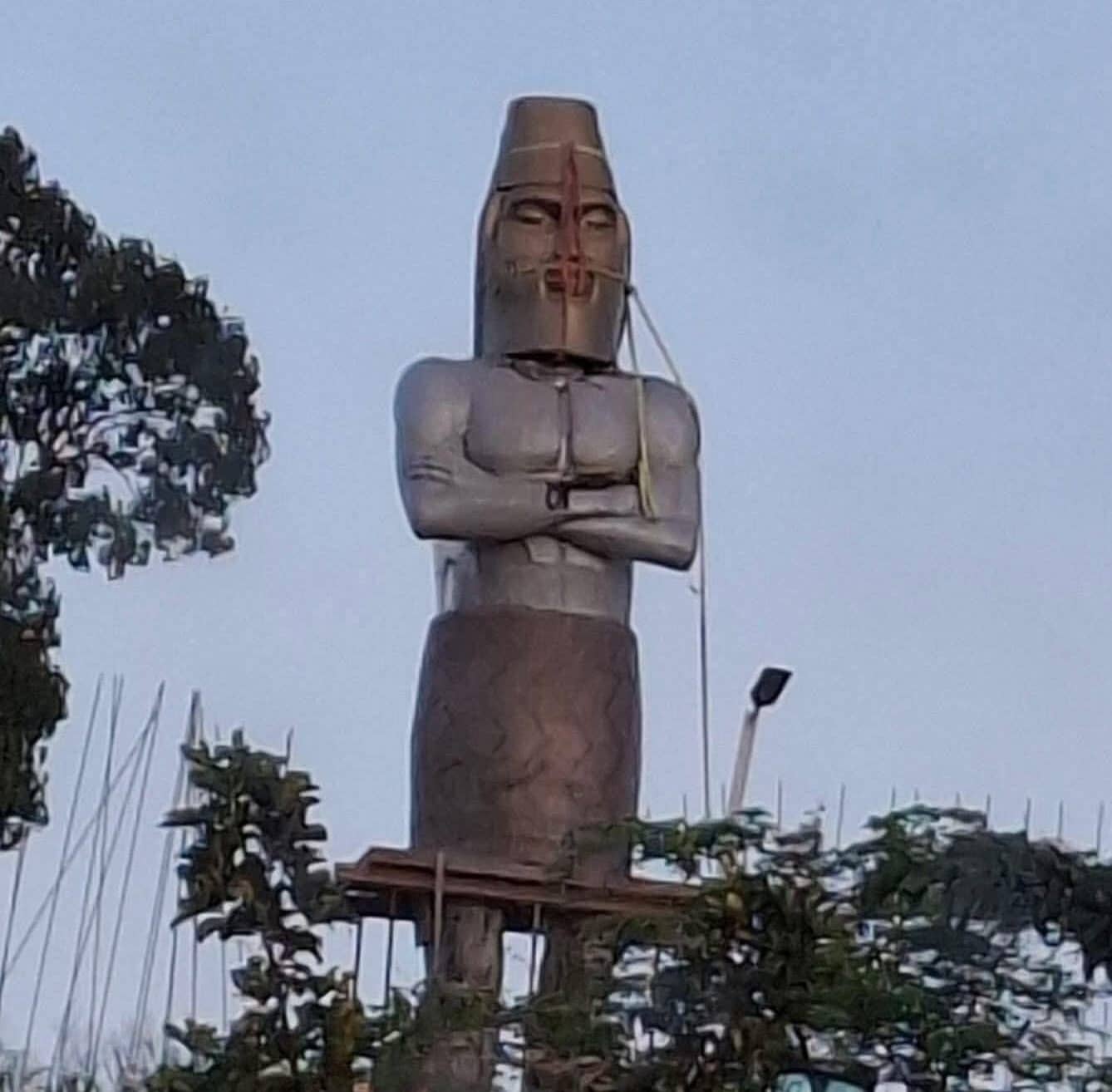
Antigua has always had statues. Stone reminders of people most of us never met, achievements we barely remember, and empires that never cared for us.
They stand quietly on church facades, in public parks, and in the hallways of power — the marble faces of saints, politicians, and colonizers alike. Nobody calls those “graven images.”
Nobody starts a crusade. Recently, an Antiguan artist has sculpted something original — something that doesn’t come from Europe’s imagination or government order — and suddenly the island’s moral compass starts spinning like a broken fan.
The latest uproar over the statue on All Saints Road isn’t about religion, art, or national pride. It’s about control. It’s about who gets to define what is sacred and what isn’t. The irony is blinding: we live in a country where corruption, deceit, and violence barely stir a whisper, but a piece of sculpted stone brings out the marching orders.
For context, the verses being thrown around — Exodus 20:4–5 and Hosea 4:6 — have been lying dormant through centuries of colonial statuary and religious decoration. Nobody quotes them at the Cathedral, nobody preaches them when they walk past the likenesses of men who helped write the nation’s inequality into law. But the moment an Antiguan dares to sculpt his own interpretation of prophecy, everyone suddenly becomes a theologian.
Let’s be honest. The outrage is pathetic. Antigua has never been a society deeply immersed in art or symbolism. We don’t have the habit of questioning what we see, as a matter of fact, it seems that in our society that “good people”, don’t rock the boat, and that’s why anything thought provoking or unfamiliar gets branded as evil.
This isn’t about blasphemy — it’s about discomfort. A local artist contracted by a religious leader and led by BIBLICAL descriptions, dared to stepped out of the narrow box this country reserves for “acceptable expression,” and that alone was enough to trigger the self-righteous.
Meanwhile, the same voices decrying a statue as “ungodly” stay conveniently silent on matters that actually degrade this island: greed masquerading as governance, exploitation dressed as opportunity, and mediocrity baptized as tradition. The moral theatre is endless — people who can’t manage decency in daily life performing outrage over a rock.
What should have been a proud moment — an Antiguan sculptor producing something daring, interpretive, and locally rooted — has instead become a spectacle of insecurity. Because the truth is, many of us still can’t tell the difference between art and idolatry, expression and offense, reflection and rebellion. And that ignorance, not any statue, is the real graven image carved into our collective conscience.
The problem isn’t that the statue stands; it’s that we, as a people, refuse to. We shrink behind borrowed morality whenever we fear thinking for ourselves. We talk about righteousness but can’t handle reflection. We claim to defend faith while betraying reason. The country has become a cesspool of convenient conviction — loud, brittle, and easily offended.
So let the so-called faithful rage. The artist has already done what few in this place ever attempt — provoke thought, awaken conversation, and, in doing so, expose the deep rot beneath our polished hypocrisy. The statue doesn’t mock faith; it mirrors us. And maybe that’s what really offends.