






















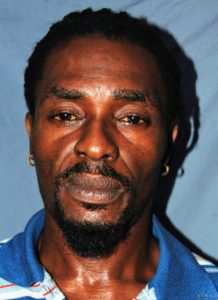
In a courtroom charged with tension and anticipation, a long-awaited murder trial is underway, set to unravel the mystery surrounding the death of Carissa Chandler.
Tedson Knowles is on trial for the alleged murder of Chandler, his common-law spouse, who was fatally shot in New Winthorpes on May 23, 2019, allegedly during a domestic dispute between them.
Expert witness Doctor Petra Miller Nanton, a senior registrar in the Sir Lester Bird Medical Centre’s Department of Pathology, provided crucial evidence.
She recounted her examination of Chandler’s body on June 13, 2019. She described the body as covered in dried blood from front to back with no clothing, noting an entry wound on the upper right side of the chest, and an exit wound on the right upper back.
Dr Nanton detailed the characteristics of the wounds, suggesting they were consistent with close-range gunshot injuries.
She elucidated that the entry wound measured 9mm in outer diameter and 7mm in inner diameter, featuring a rim of burnt tissue and a discoloration spanning 1cm in diameter on the external surface.
Explaining the significance of burnt tissue around the entry wound, Nanton indicated that it typically occurs in close-range shootings due to the heat generated by the bullet.
The doctor described the exit wound as star-shaped or ragged, with an outer rim measuring 16mm in diameter and inner rim measuring 11mm. She concluded that the shape and size of the wound suggested Chandler was shot from the front.
The doctor also observed haemorrhaging in the chest area and noted that many of her organs appeared extremely pale.
She attributed Chandler’s death to exsanguination, or massive blood loss, resulting from the gunshot wound to her chest.
In cross-examination, defence attorney Wendel Alexander attempted to challenge Nanton’s conclusions, suggesting alternative scenarios for Chandler’s injuries.
However, Dr Nanton stood by her assessment, maintaining that the evidence pointed to gunshot trauma as the cause of death.
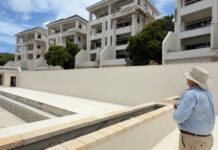
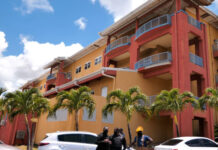
Before Nanton’s testimony, preschool teacher Simone Abbott-Daniel who lived in the same apartment complex as the accused and the deceased, provided her account of the events leading up to Chandler’s death.
The accused lived above the witness and there were two other apartments in the complex.
Abbott-Daniel, recalled hearing a heated argument between the couple on the evening of May 22, 2019.
The witness described a series of events, including the sound of items breaking and falling, as well as shuffling noises, with the accused’s voice being louder than the deceased’s.
Despite her husband’s efforts to call the police, none showed up at the time.
Subsequently, the situation appeared to calm down momentarily. However, an ambulance arrived but departed without transporting a patient.
Later, the witness heard furniture being moved and overheard a calmer discussion between the two individuals.
Shortly after, she heard a loud noise which she described as “an explosion” and later heard footsteps and Chandler calling out to some of the neighbours saying “Help me!”
As she approached the back door, she overheard Chandler uttering, “I cannot breathe.”
Stepping outside, she discovered Chandler lying at the bottom of a staircase.
Shortly after, she witnessed Knowles pulling-up in his vehicle, lifting Chandler into the car, and driving away.
Her husband then contacted the police once more, and they finally came.
Additionally, the witness recounted an incident from two weeks prior, where the defendant threatened the deceased saying that if he had a gun, he would shoot her.
The emotional impact of her testimony was palpable, evidenced by the sobbing of Chandler’s family members in the courtroom.
In cross-examination, the defence probed the accuracy of Abbott-Daniel’s observations, seeking to challenge the reliability of her testimony.
The trial continues on Tuesday as the prosecution presents further evidence to establish Knowles’ culpability in Chandler’s death.