
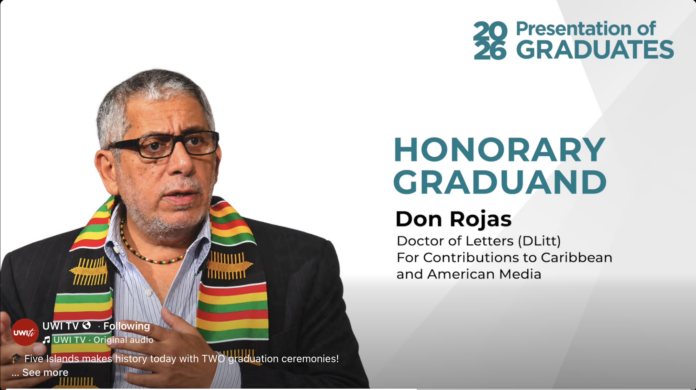

Veteran journalist and social justice advocate Don Rojas received an honorary Doctor of Letters from the University of the West Indies Five Islands Campus in Antigua and Barbuda on Saturday, recognizing more than five decades of work connecting the Caribbean with the global African diaspora.
Rojas, who said ill health prevented him from attending the graduation ceremony in person, used his recorded response to urge graduates to strengthen those connections, defend Caribbean sovereignty and support the people of Cuba.
“My life’s mission as a journalist, a communications professional, and a social justice advocate has been to build bridges between the Caribbean and the global African diaspora,” he said.
The university’s citation traced a career spanning Caribbean revolutionary politics, Black journalism, digital media and the campaign for reparatory justice. It presented Rojas as a communicator whose work carried ideas across national borders and generations.
Kareem Maceo Rojas accepted the honor on his behalf during the afternoon ceremony.
Rojas said recognition from his community held particular significance.
“There are moments in a life’s journey when the recognition of one’s community means more than any individual achievement,” he said. “And this is one of those moments for me.”
He described communication between Caribbean people and the African diaspora as essential to a shared struggle for liberation. Those connections, he said, must extend beyond geography to encompass history, culture and a sense of common purpose.
“And I want to be clear, that work of bridge building is never finished,” Rojas said.
“Every generation must take up the tools and build anew,” he added, urging successive generations to extend the work of their predecessors as new challenges emerge.
Born in St. Vincent and the Grenadines to a Trinidadian father and a Vincentian mother, Rojas grew up in a family shaped by broadcasting, according to the citation.
His father, a radio producer and broadcaster, introduced him to the microphone at age 9 through a radio drama about an African boy growing up in the Caribbean during slavery.
His father’s work also took the family across the region, with Rojas attending school in Grenada, St. Vincent and the Grenadines, St. Lucia, and Trinidad and Tobago. The citation described those experiences as an early education in adaptability and Caribbean unity.
Rojas moved to the United States in 1968 and studied journalism and political science at the University of Wisconsin. Early positions followed at the National Urban League and the Afro-American newspaper in Baltimore, where his reporting brought him into contact with leaders from Africa and the diaspora, as well as Jamaican musician Bob Marley.
A major turning point came in 1979, when his childhood friend Maurice Bishop, then prime minister of Grenada, visited the United Nations to speak about the Grenada Revolution.
According to the citation, Rojas returned to Grenada within 10 days to help develop its print and broadcast media. He served as editor-in-chief of the Free West Indian newspaper and later became Bishop’s press secretary.
His work included helping organize a conference of Caribbean intellectual workers and hosting visiting international figures.
In his response, Rojas described Bishop as an enduring source of inspiration, praising his commitment to sovereignty, justice and human dignity.
“I had the extraordinary privilege of serving as his press secretary,” he said, “and I carry the lessons of that experience with me every day.”
The citation also recalled the upheaval that followed the collapse of Bishop’s government and the U.S. invasion of Grenada in 1983.
Four days after the invasion, Rojas and his family were deported to Barbados aboard a U.S. Air Force aircraft, according to the account read at the ceremony. Their subsequent journey took them through Trinidad and Tobago and Canada.
The university described that period as a test of his ability to adapt and rebuild.
Rojas later served as a senior executive of the International Organization of Journalists in Prague. The citation credited him as the only Caribbean national to hold such a post at the time and the only Black journalist to cover the first summit between U.S. President Ronald Reagan and Soviet leader Mikhail Gorbachev in Geneva.
After returning to the United States in the early 1990s, he became executive director of the New York Amsterdam News and, in 1993, the first director of communications for the NAACP.
His career subsequently expanded into digital media. The citation credited him with founding The Black World Today, an early digital magazine, and Black World Radio, an internet radio initiative.
He also led WBAI in New York and served as executive director and chief executive of Free Speech TV.
The university identified his continuing roles as director of communications and international relations at the Institute of the Black World 21st Century and general manager of the Black World Media Network.
His relationship with UWI included serving as a senior adviser to Vice Chancellor Sir Hilary Beckles and providing a blueprint for UWI TV, according to the citation.
The university also recognized his work linking Caribbean and U.S. reparations campaigns, including helping launch the National African American Reparations Commission.
In his response, Rojas praised Beckles’ leadership of the CARICOM Reparations Commission and its connections with advocates in Africa, the United States, Europe and Latin America.
He also identified Marcus Garvey, Bishop, Marley and calypsonian the Mighty Sparrow as figures whose work helped connect Caribbean and African peoples through politics, music and cultural expression.
“These are the giants on whose shoulders we stand,” he said. “And it is our sacred obligation to be worthy of their legacy.”
Rojas devoted part of his address to Cuba, calling on Caribbean people to express solidarity with its population and advocate for an end to the U.S. economic embargo, which he described as an unjust blockade.
“We owe them our solidarity, our voice, and our active advocacy for the lifting of this unjust blockade,” he said.
“Their struggle is our struggle. Their dignity is inseparable from our own.”
Addressing the graduating class, Rojas said their education had prepared them to contribute intelligence, creativity, cultural pride and moral courage to a troubled world.
“You are the rising generation of Caribbean leadership,” he said, describing graduates as people ready to shape the region’s future and build connections capable of enduring across generations.
“Do not underestimate what you carry,” he urged.
The citation also recognized the support of his wife, Karen Codrington Rojas, throughout his career and the family’s years of upheaval. It said the couple have four adult children and 11 grandchildren.
Closing his response, Rojas said the honorary degree had strengthened his commitment to justice, solidarity and communication.
“I did not expect it, I do not take it lightly, and I will spend whatever productive years remain trying to be worthy of it,” he said.
He ended with a phrase associated with the Grenada Revolution: “Forward ever, backward never.”
Source: Antigua News Room UWI Five Islands awards veteran journalist Don Rojas honorary Doctorate.